Most people meet Rolfing® Structural Integration as a set of techniques. Dr. Ida P. Rolf saw it first as a way of thinking about the body. This article follows that thinking: the questions she asked, and where they led.
Dr. Rolf trained as a scientist, earning a PhD in biological chemistry from Columbia University in 1920. She approached the body the way a chemist approaches a compound. What is it made of? What holds it together? What forces act on it? Her answers became the foundation of the work Certified Rolfers™ still do today.
Gravity: the force we never escape
Start with the one force every body lives with, every second of every day: gravity. Most of us only notice it when we fall. Dr. Rolf asked a different question. What happens to a body that is slightly out of line with gravity, for decades?
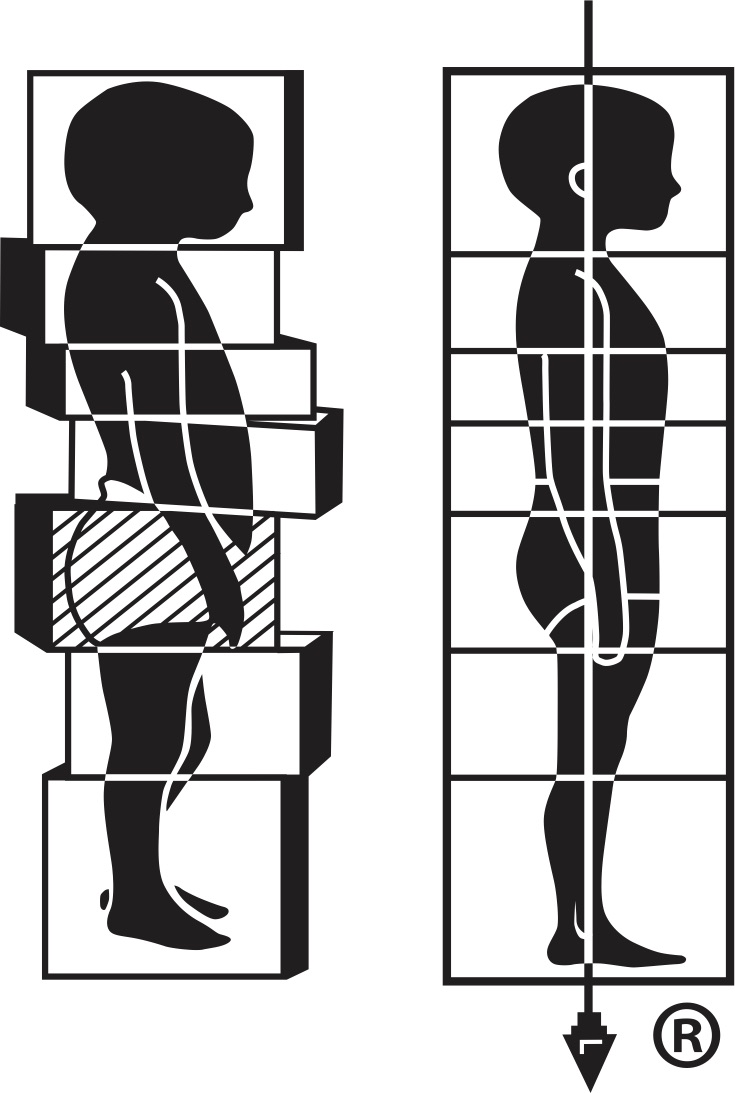
Picture a stack of children’s blocks. Stacked straight, gravity holds them together. Shift one block forward, and the whole stack has to work to stay up. A body is the same. When the head drifts forward or the pelvis tips, muscles brace and tissue tightens just to keep you upright.
That led to the insight she is best known for: gravity can be a problem or a support. In a balanced body, gravity flows through and lifts. In an unbalanced one, it pulls you down. The goal of Rolfing is not to fight gravity, but to organize the body so gravity can help.
Fascia: the fabric that holds your shape
Next question: if the body is out of line, what is holding it there? Dr. Rolf’s answer was fascia, the connective tissue that wraps every muscle, bone and organ. She called it the organ of structure.
Think of fascia as a full-body web, like the white film around an orange’s segments. It gives you your shape. When you favor an injury, sit at a desk for years, or brace against stress, this web adapts and holds the pattern. Over time, the pattern starts to feel normal.
Here is the hopeful part. Fascia is not fixed. It responds to skilled, slow pressure and to new ways of moving. If the tissue can change, so can the body’s shape. A body that has organized itself around old habits can reorganize around something better.
The whole body, not the sore spot
Because fascia connects everything, Dr. Rolf would not treat a body one piece at a time. A stiff neck might begin with a rotated pelvis. Sore knees might trace back to how the feet meet the ground. A saying often linked to her captures it: where you think it is, it isn’t.
This is why a Rolfer may work on your ribs or ankles when you came in for shoulder pain. The question is never only “what hurts?” It is “what is the whole body doing, and why?”
She also held that structure and function go together. How you are built shapes how you move, and how you move shapes how you are built. Change one, and the other follows.
Order: why the 10-Series has a sequence
If the whole body is connected, the order of the work matters. Release one area too early, and the body simply shifts the strain somewhere else. So Dr. Rolf designed a sequence, now called the classic 10-Series, that builds change step by step.
- Sessions 1–3, the sleeve. Work with the outer layers: breath, feet and legs, and the sides of the body. The goal is room to move.
- Sessions 4–7, the core. Work with the deeper structures: inner legs, pelvis, spine, neck and head. The goal is support from the inside.
- Sessions 8–10, integration. Bring the parts together so the body moves as one coordinated whole.
Her central image was a vertical line: a body balanced around it, from the top of the head to the feet. The aim is not a stiff, military posture. It is a body organized around that line, so standing and moving take less effort.
Ease: what a balanced body feels like
Follow the thinking to its end, and the goal is not a body that looks “correct.” It is a body that feels easy to live in. When the parts stack well and the tissue is free, gravity supports you instead of pressing you down.
Clients often describe it simply: standing taller without trying, breathing more fully, walking with less effort. Dr. Rolf believed that a body in better order could adapt and recover more easily on its own.
That is the heart of it. Rolfing does not impose a shape on you. It helps your body find its own balance, between the ground beneath you and the space above you, so you can feel more at home in your body.
Written by Paige Dayvis, Certified Rolfer™, Center of Integration, Lutz, FL. Learn more or book a session at paigetherolfer.com.

